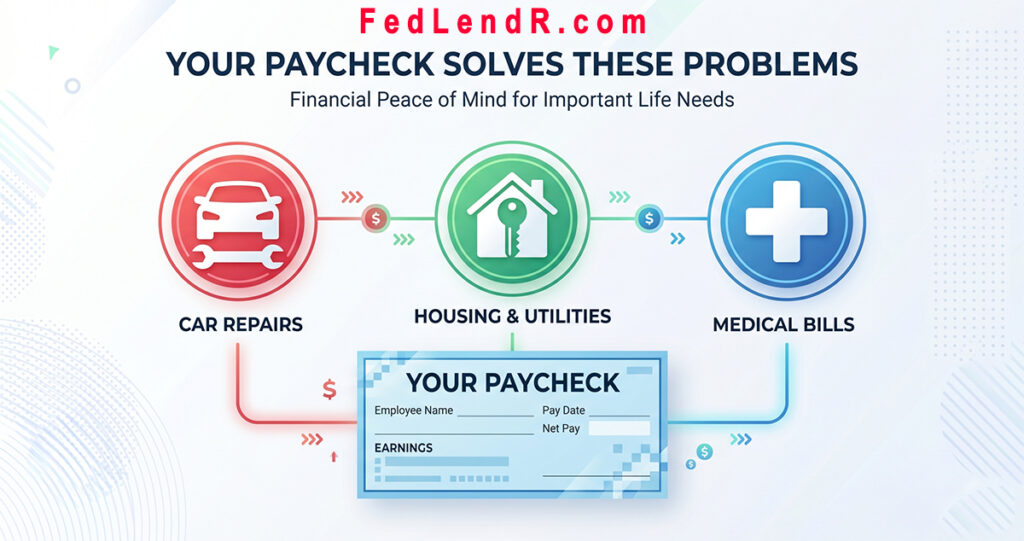
An emergency allotment loan is a personal installment loan for federal government employees and USPS workers, with funds available as soon as the next business day.
If you need money for a car repair, rent gap, or medical bill, your federal employment is the primary qualification, not your credit score. The lender sets the amount based on your income and your state.
An allotment loan is repaid through automatic payroll deduction, meaning the payment comes out of your paycheck before it hits your bank account.
No missed payments.
No bounced checks.
One short application, and the money moves fast.
Here’s what that looks like in real life.
After you tap “See My Loan Options,” your request continues on our lending partner’s secure application page. That page uses a different name than FedLendR. That is normal. Finish your application there to see your loan options.
🚗 $1,500 Car Repair
The Transmission Blew: A $1,500 Car Repair You Didn’t Budget For
Your car is how you get to work. No car, no paycheck.
A transmission repair runs $1,500 to $3,500, depending on the vehicle.
Your savings account has $200 in it.
Your credit union already said no because your score is 560.
The mechanic needs a deposit by Friday, or your car goes to the back of the line.
Here’s how a $1,500 allotment loan works: it comes back in fixed payroll deductions over a set term. Your offer shows the exact payment, APR, and total of payments.
Make sure that payment fits your budget before you accept.
And because it’s deducted before your paycheck hits your bank account, you can’t accidentally spend it.
The alternative? Uber to work for three weeks at $25 a day while you wait for a “better option” that never comes.
That’s $375 in ride costs.
Or you miss shifts and lose more than the loan would have cost.
The car gets fixed.
You keep getting to work. The loan pays down to zero on a fixed schedule.
$1,500 loan → fixed payroll deductions → a real end date
🏠 $2,000 Rent Gap
Rent Is Due in 6 days, and you’re $2,000 Short
Government shutdowns.
Furloughs.
A spouse who lost a job.
A medical bill that drained the checking account.
It doesn’t matter how you got here.
What matters is that rent is due and you’re short.
Late rent means a late fee.
After that, it means an eviction notice.
After that, it follows you.
On an allotment loan, that $2,000 comes back in fixed payroll deductions over a set term. Your offer shows the exact payment, APR, and total of payments.
You keep your apartment.
You keep your address.
You keep your stability.
This is where allotment loans differ from payday loans or credit card cash advances.
A payday loan (if you could even get one that size) comes with rollover fees that can double the cost within 60 days.
A credit card cash advance hits you with a higher interest rate from day one and no grace period.
An allotment loan is a fixed installment with principal paydown.
Every payment shrinks the balance. There is a real end date.
If you’re a USPS employee, the allotment is set up through PostalEASE.
If you’re at any other federal agency, it’s handled through your agency’s payroll portal.
The regulation that authorizes this is 5 CFR 550, Subpart C, which permits voluntary payroll deductions for any legal purpose, including loan repayment.
$2,000 loan → fixed payroll deductions → a real end date
⚕️ $3,000 Medical Bill
The ER Visit That Cost $3,000
You didn’t plan to go to the emergency room. Nobody does.
But the bill is real. $3,000.
Your insurance covered part of it. Your deductible ate the rest.
The hospital’s billing department is already calling. If you don’t set up a payment plan or pay in full within 60 to 90 days, it goes to collections.
Once it’s in collections, it’s on your credit report.
And if you hold a security clearance, unpaid collections create exactly the kind of Guideline F red flag you don’t want.
Here’s the fix.
On an allotment loan, that $3,000 comes back in fixed payroll deductions over a set term. Your offer shows the exact payment, APR, and total of payments.
You pay the hospital.
The bill disappears.
The allotment loan is paid down on a fixed schedule automatically, with no action required from you after setup.
Compare that to the minimum payments on a credit card.
Put $3,000 on a card at 24.99% and pay minimums, you’ll spend over 10 years and thousands in interest digging out.
The allotment loan has an end date.
The credit card minimum does not.
See what you can borrow. Your credit score is not the primary factor. Your federal employment is.
$3,000 loan → fixed payroll deductions → a real end date
Why Federal Employment Changes the Equation
Traditional lenders look at your credit score first. If it’s below 620, the door closes before you finish the application.
Allotment loan lenders look at something else: your paycheck.
Federal employees and USPS workers have one of the most stable sources of income in the country.
Federal pay arrives on a set schedule, every pay period. That stability is what the lender underwrites against.
When your repayment is automatically deducted from your federal paycheck, the lender’s risk decreases.
Lower risk for them can mean access for you, even with a score in the 500s.
This isn’t a workaround. It’s how the product is designed.
The allotment loan exists specifically because federal employment provides the kind of repayment certainty that credit scores were invented to predict.
You already have what the lender needs.
Your job IS the qualification.
For a full breakdown of eligibility and how the process works step by step, read the complete guide to how allotment loans work.
What to Know Before You Apply
A few things worth knowing before you click:
The application is short. You’ll need your name, agency or postal employment details, income, and the amount you want to borrow.
Your credit score is not the primary factor. Your federal employment is. Ask the lender how and when it checks your credit before you move forward.
Funding is fast. Funds can be available as soon as the next business day.
You are not locked in. Getting a loan offer does not obligate you to accept it. Review the terms. Check that the monthly deduction works with your budget. If the numbers don’t fit, walk away. No penalty.
The loan pays down principal on every payment. This is not a revolving balance. Every deduction reduces what you owe. The loan has a fixed end date. You will not be making these payments forever.
FAQ
Q: How fast can I get funded for an emergency allotment loan?
A: Funds can be available as soon as the next business day, depending on the lender and when you apply. The application is short. If your emergency has a hard deadline, apply early in the business day.
Q: Can I use an allotment loan for any type of emergency?
A: Yes. Car repairs, rent, medical bills, emergency travel, appliance replacement, funeral expenses. It is a personal loan, and you decide where the money goes. If a lender has use restrictions, they will be in the loan agreement.
Q: What if my credit score is below 600?
A: Your credit score is not the deciding factor. The lender’s primary consideration is your federal employment and income. A score in the 500s does not automatically rule you out. The payroll allotment gives the lender repayment certainty that a credit score alone does not provide. Check what you can borrow here.
Q: How much will my paycheck decrease?
A: It depends on the loan amount, the repayment term, and the lender. Before you accept any offer, the lender will show you the exact deduction amount, the APR, and the total of payments. Make sure it fits your budget. If it doesn’t, ask about a longer term to reduce the monthly amount.
Q: What happens if there's a government shutdown?
A: During a shutdown, payroll allotments may be paused because paychecks are paused. Ask your lender how it handles a shutdown before you sign. Once the shutdown ends and back pay is issued, allotments resume. If you’re concerned about shutdowns, read the emergency funds guide for federal workers for more detail on how to prepare.
Q: Is this different from a payday loan?
A: Very different. A payday loan is a short-term, lump-sum loan (usually due on your next payday) with high fees that can lead to rollover cycles. An allotment loan is a multi-month installment loan with fixed payments and principal paydown. You repay over a set number of months, not in one lump sum on your next payday. Every payment reduces what you owe. There is no rollover trap.
The emergency is real.
The fix doesn’t have to be complicated.
Your federal employment qualifies you.
After you tap “See My Loan Options,” your request continues on our lending partner’s secure application page. That page uses a different name than FedLendR. That is normal. Finish your application there to see your loan options.

Jer Ayles
Last updated: October 2026.
FedLendR.com is an affiliate marketing site. We may receive compensation when you click links and apply for loan products featured on this site. Loan approval, amounts, rates, and terms are determined solely by the lender and are not guaranteed. Not all applicants will qualify. Loan products and availability vary by state. FedLendR.com is not a lender and does not make credit decisions.
Federal Employee Allotment Loans for Emergencies: A Simple Guide
How payroll allotment loans work, the risks, and a checklist before you apply.
How Allotment Loans Work
Step-by-step from application to funding to payroll deduction, in plain English.
Allotment Loans for USPS Postal Employees
Loan options for postal workers, including PostalEASE setup instructions.
Do Allotment Loans Affect Security Clearance?
What Guideline F actually looks for and why a loan may help, not hurt, your clearance.
Allotment Lenders Compared (2026)
Updated comparison of allotment loan options for federal workers this year.
Emergency Funds for Federal Workers
What to do when you need cash fast and your credit union said no.
The Straight-Talk Guide to Allotment Loans
Everything about allotment loans for federal employees, explained without the jargon.