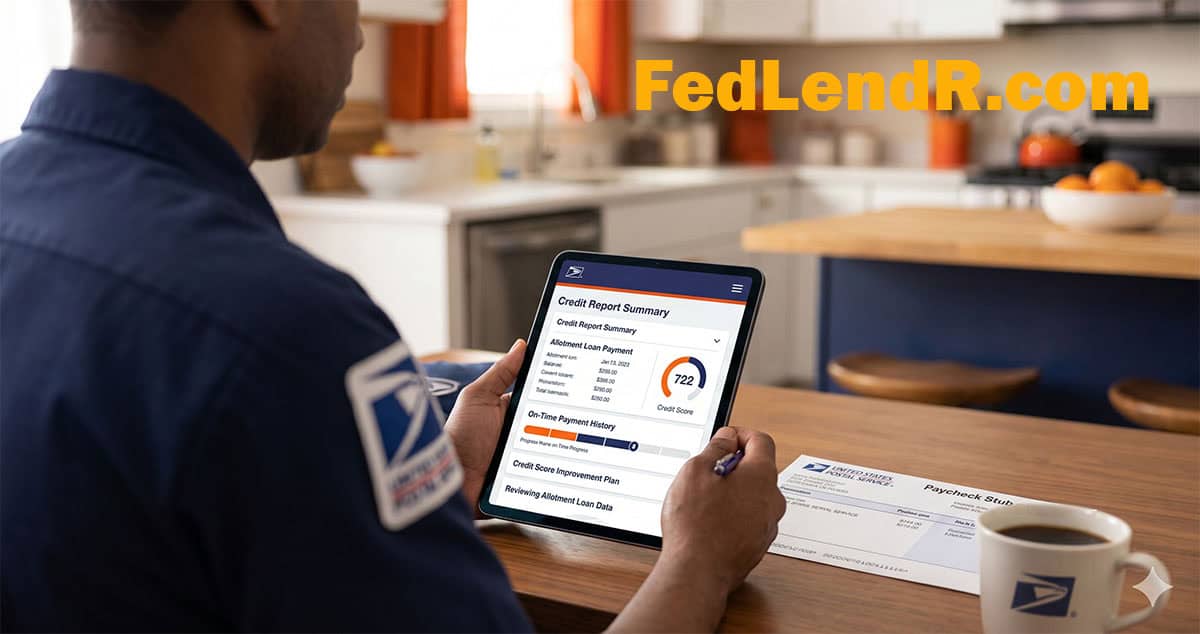
USPS Employees: How an Allotment Loan Can Help Your Credit
Last updated: October 2026.
If you work for the U.S. Postal Service and your credit score isn’t where you want it, you have a tool most people don’t know about.
An allotment loan repays itself through your USPS paycheck before the money ever hits your bank account.
That means the payment is made for you, every payday.
And in FICO’s scoring model, payment history is the single biggest factor.
One loan. Two wins: help with the bill in front of you, and a better credit score built automatically over the next 6 to 48 months.
What Is a Payroll Allotment Loan?
An allotment loan is a personal installment loan built specifically for federal government employees and USPS workers.
You apply, the lender decides based primarily on your employment and income, and you repay through automatic payroll deduction.
The payment comes out of your paycheck first. Not after. Not when you remember. First.
That single mechanic changes the credit equation entirely, and we’ll get to exactly why in a moment.
Loan amounts are set by the lender based on your state and your income.
Terms range from 6 to 48 months, depending on how much you borrow and what your monthly payment needs to be.
Your credit score is a factor, but it is not the deciding factor. Your USPS employment is.
Why Your Paycheck Is the Unlock
Most loans start with your credit score. The lender pulls your file, sees a 540, and that’s the end of the conversation.
Allotment loans are built on a different model entirely.
Lenders who offer allotment loans to USPS employees are evaluating your income and your employment, not your credit history, as the primary qualifier.
They know the payment comes out of your federal paycheck before you ever see it. That changes the risk equation completely.
This is called income-first underwriting.
The lender isn’t betting on your willpower.
They’re looking at your USPS direct deposit and a payroll deduction mechanism that makes your payment automatic and hard to miss.
Your credit score still matters.
But a USPS paycheck with a working allotment setup matters more.
That’s why a score in the 500s does not automatically rule you out.
The paycheck is not just how you repay the loan. It’s the main thing the lender looks at.
The Credit Score Factor No One Talks About
The Consumer Financial Protection Bureau publishes a credit education guide called Your Money, Your Goals. It breaks down exactly what goes into a credit score.
Here’s the short version, ranked by impact:
Payment track record carries the most weight.
Do you pay on time, consistently? That single factor has more impact on your score than your account balances, your mix of credit types, or how long you’ve held accounts.
The other factors, balances, how much of your available credit you’re using, the types of accounts you hold, matter too.
But nothing moves the needle faster than a clean, consistent payment history.
- An allotment loan is engineered to produce that exact outcome.
- Every payment.
- Every cycle.
- No exceptions.
| Credit Score Factor | What It Measures | How Allotment Loan Affects It |
|---|---|---|
| Payment Track Record Most Weight | Do you pay on time, every time? | Payroll deduction makes every payment automatic and on time. Maximum positive impact when the lender reports to the credit bureaus. |
| Balances | Are your balances low relative to what you owe? | Each payment reduces your principal balance. The loan pays down over time, improving your debt-to-income picture. |
| Use of Available Credit | Are you near your credit limits? | An installment loan does not count against revolving utilization the way a credit card does. Minimal impact on this factor. |
| Types of Credit + Length of History | Do you have experience with different kinds of accounts? | Adds an installment loan to your credit mix. Thin files benefit most. This type of account may be missing entirely. |
How Payroll Deduction Builds Credit Faster
Here is the mechanical reason this works.
Most people who miss loan payments don’t miss them because they don’t have the money.
They miss them because life gets in the way.
The due date passes.
Something else came up.
The automatic payment didn’t process. The money was already spent.
An allotment deduction removes every one of those failure points.
Your USPS payroll office deducts the payment before your paycheck clears.
It happens the same day every pay period. You do not log in. You do not transfer funds. You do not remember a date.
The lender reports that on-time payment to the credit bureaus. Every cycle. Every time.
Over 12 months, that’s 24 or 26 on-time payments added to your credit history. Clean. Consistent. Exactly what the scoring models are looking for.
If your credit file is thin, this is how you build substance. If your credit file has old damage, this is how you start layering positive history over it.
After you tap “See My Loan Options,” your request continues on our lending partner’s secure application page. That page uses a different name than FedLendR. That is normal. Finish your application there to see your loan options.
Who Qualifies?
The short answer: if you have a USPS paycheck, you have a strong shot.
The primary qualifiers are your employment status and your income.
Lenders offering allotment loans to postal workers understand that a USPS payroll job with automatic deduction has a fundamentally different risk profile from that of a traditional bank loan.
Credit score matters, but it is not the wall that stops you.
The payment structure, your employer remitting your payment directly, gives the lender the confidence to work with borrowers who have scores below what a bank would consider.
Bad credit, thin credit, or even past delinquencies that have aged a few years: the allotment structure changes the conversation with the lender.
What does NOT qualify you:
- active default
- active bankruptcy
- working for an employer that does not process payroll allotments.
- USPS processes them. That is why this product exists for postal workers.
The 5-Step Application Process
The process is straightforward. It does not require a branch visit, a mountain of documents, or days of waiting.
Step 1: Fill out the form on this page. You will need your employment information, income, and bank account details for funding.
Step 2: The lender reviews your application and tells you its decision.
Step 3: Once approved, you sign the loan agreement. The allotment is set up with your USPS payroll, and funds are deposited to your account, often as soon as the next business day.
Step 4: Payments deduct automatically from your paycheck. You do not manage this. The payroll office handles it.
Step 5: Each on-time payment gets reported to the credit bureaus. Your score begins to build.
Frequently Asked Questions
Q: Does an allotment loan actually get reported to the credit bureaus? A: Many allotment loan lenders report your payments to the credit bureaus (Equifax, Experian, and TransUnion), but not every lender does, and some do not report to all three. Before you sign, ask the lender which bureaus they report to. If they do not report, your on-time payments will not build your credit.
Q: My credit score is below 580. Can I still apply? A: Yes. Your credit score is not the primary factor. Your USPS employment is. Payroll deduction lowers the lender’s risk, which is why lenders look past the number. Every lender sets its own rules, and not every applicant will qualify. When you are ready, compare your options with the form on this page.
Q: How much can my credit score actually improve? A: Nobody can promise you a specific number. Scoring models vary and your full credit profile matters. What is true: on-time payment history is one of the biggest factors in your score. Twelve months of clean, reported allotment payments can move it, especially if you have a thin file or older negative marks aging off.
Q: Will applying hurt my credit score? A: Lenders handle credit checks differently, so ask before you sign anything. If a lender does a hard credit pull, that inquiry usually causes a small, temporary dip. Over time, months of on-time payments carry far more weight than one inquiry.
Q: What happens if I transfer to a different postal facility or leave USPS? A: The allotment deduction follows your USPS employment as long as you are on payroll. If you leave USPS, the lender typically switches to bank draft repayment. The loan does not disappear. You simply continue making payments directly. For more detail on how the full allotment process works, see our guide to how allotment loans work.
Q: Is this the same thing as a payday loan? A: No. An allotment loan is a personal installment loan with fixed monthly payments over a term of 6 to 48 months. A payday loan is a short-term, high-fee product that pulls the full balance from your bank account on your next payday. They are structurally different products. For USPS workers specifically, see our full breakdown on allotment loans for postal employees.
After you tap “See My Loan Options,” your request continues on our lending partner’s secure application page. That page uses a different name than FedLendR. That is normal. Finish your application there to see your loan options.
Allotment Loans for USPS Postal Employees
Everything postal workers need to know about qualifying, applying, and what to expect from payroll deduction loans.
How Allotment Loans Work
The step-by-step process from application to funding to payroll deduction, in plain English.
Allotment Loans for Federal Employees: The Full Guide
Top options for federal workers in 2026: compared by loan amounts, terms, and what each lender looks for.
Emergency Funds for Federal Workers
When the car breaks down, the rent is due, or the medical bill lands: what your options are and how fast you can move.
Allotment Loan Options Compared
Side-by-side comparison of the top allotment loan options available to federal and postal workers this year.
Allotment Loans for Federal Employees and USPS Workers
The complete guide: who qualifies, how payroll allotment works, and why employment matters more than credit score.
Written by Jer Ayles | 20+ years in consumer lending | About FedLendR